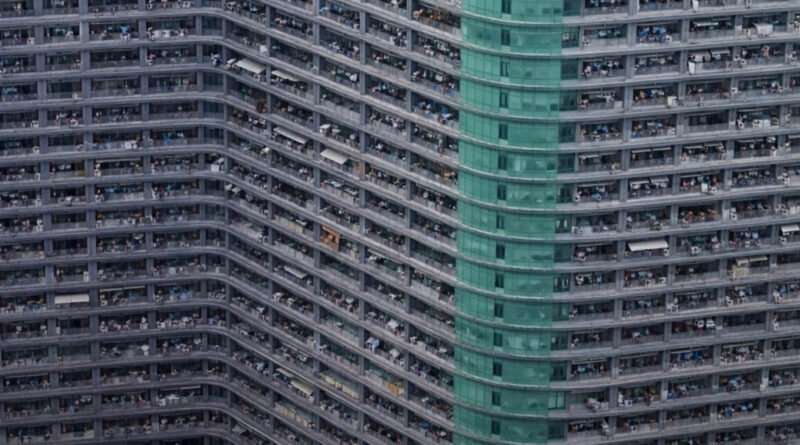
Inside a ‘Dystopian’ Apartment Block Where That Houses Over 20,000 Residence
In Hangzhou, the massive Regent International apartment complex has captured worldwide attention for both its astonishing scale and its almost city-like design. Rising approximately 675 feet into the sky and curving in a dramatic S-shaped form, the structure dominates the surrounding skyline and stands as one of the boldest examples of ultra-dense residential architecture in the modern world. Designed by Alicia Loo, the building is often described as one of the most ambitious experiments in high-density urban living ever attempted. With enough capacity to accommodate as many as 30,000 residents, it ranks among the most densely populated residential developments on Earth.
Today, an estimated 20,000 people live inside this single complex, creating a self-contained environment that functions almost like its own vertical neighborhood. Within the building, residents have access to an impressive range of everyday amenities, including gyms, convenience stores, salons, food courts, offices, and a wide variety of retail shops. The concept is simple but powerful: reduce the need for long commutes by placing the essentials of daily life just an elevator ride away. In many ways, the complex reflects a larger trend seen across fast-growing Chinese cities, where mixed-use megastructures are increasingly being used to respond to urban crowding and limited land availability.
Supporters of the project view it as a striking example of efficient and forward-thinking urban design. They argue that developments like this offer a practical solution to some of the most pressing challenges facing modern cities, particularly in places where expansion outward is limited by geography, cost, or environmental concerns. By stacking homes, services, and businesses into a single vertical footprint, Regent International demonstrates how architecture can dramatically reduce pressure on surrounding neighborhoods while maximizing the use of valuable urban land.
Yet for all its innovation, the complex also raises important questions about what life inside such an immense structure actually feels like. Critics argue that extreme density can create isolation even in the middle of constant proximity, leaving residents physically close to one another while emotionally and socially disconnected. Smaller living spaces, reduced privacy, and heavy dependence on indoor environments can all take a toll on quality of life. For many observers, the building highlights an increasingly urgent concern in urban planning: whether efficiency alone is enough to create spaces where people can truly thrive.
Another major concern is access to fresh air, natural light, and meaningful outdoor space. While some units include balconies or access to shared garden areas, many residents depend largely on indoor common spaces rather than open courtyards, parks, or private outdoor retreats. This has fueled a wider conversation among architects and urban planners about what makes housing feel not just functional, but genuinely humane. Can convenience and density replace the emotional and physical benefits of open space, sunlight, and a quieter connection to the outside world? That question remains central to the debate surrounding buildings like this.
To many urban planners, Regent International represents both a remarkable achievement and a cautionary symbol. On one hand, it proves that architecture can respond boldly and creatively to the demands of modern city life. On the other, it reveals the deep social and psychological complexity that emerges when thousands of people share a single towering structure. Some experts see it as a glimpse into the future of urban living — a future shaped by innovation, necessity, and compromise.
Defenders of the building argue that cities simply have no choice but to evolve. As populations grow and housing shortages intensify, they believe creative high-density solutions will become increasingly necessary. But even many supporters agree on one critical point: if vertical living is going to shape the future, then human well-being must remain at the center of the design conversation.
As the skyline of Hangzhou continues to expand, Regent International remains one of the clearest symbols of modern urban ambition — a bold and fascinating experiment in how people may live tomorrow, and a reminder that the future of cities must balance progress, practicality, and the human need for space, light, and connection